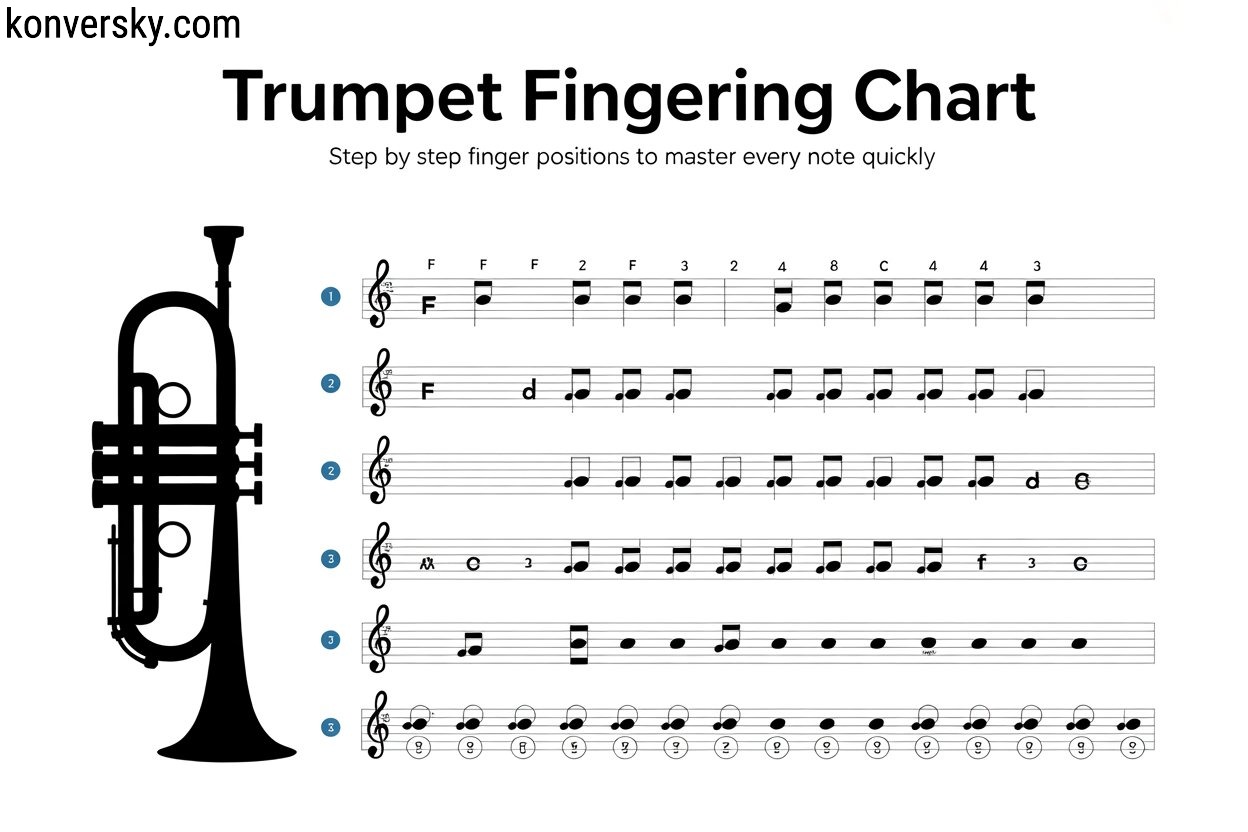
Trumpet fingering chart: step by step finger positions to master every note quickly
Introduction
The trumpet is a bright and powerful musical instrument loved worldwide. Its sound can lead an orchestra, shine in a jazz band, or add energy to a marching performance. Many people are drawn to the trumpet for its expressive range and ability to create memorable melodies. Learning the trumpet opens doors to multiple music styles and allows musicians to explore their creativity. Whether playing classical, jazz, or contemporary pieces, this instrument offers countless opportunities to develop skill and confidence.
Playing the trumpet well requires more than just blowing air. Proper finger placement is essential to hit the correct notes, and a trumpet fingering chart can guide beginners in learning the correct positions. Even small mistakes in fingering can make the music sound uneven or out of tune. Understanding how the valves work and which fingers to use is key for smooth performance. Using a trumpet fingering chart regularly helps improve accuracy, speed, and tone. Consistent practice trains the fingers to move naturally, making even complex passages easier to play and increasing overall control.
This guide provides a step-by-step method for mastering every trumpet note. By following the trumpet fingering chart, you will learn clear and practical techniques to play each note accurately. With regular use of the trumpet fingering chart, you can confidently move through scales, melodies, and challenging passages. Over time, every note will feel natural, your playing will become more precise, and your confidence will grow. By the end, you will be ready to play every note smoothly and enjoyably, mastering the trumpet with ease using the trumpet fingering chart.
Understanding the Basics of Trumpet Fingering
The trumpet has three main valves that control the pitch of each note. Pressing a valve changes the path of air inside the instrument. This adjustment alters the sound, allowing you to play different notes accurately. Each valve is connected to tubing that lowers the pitch in small steps. Learning how these valves work is essential for smooth playing. Understanding the basics of valve function helps beginners play clear, precise notes from the very start.
Standard finger positions are simple once you practice them consistently. The index finger usually presses the first valve, the middle finger the second, and the ring finger the third. Many players also use the pinky to stabilize the third valve slide. Correct finger placement prevents unnecessary tension and allows faster, smoother transitions between notes. When your fingers know the positions naturally, you can focus on sound, rhythm, and expression instead of worrying about fingering mistakes.
Combining the valves produces the full range of notes on the trumpet. Pressing only the first valve lowers the pitch slightly, while the first and second together lower it further. Using all three valves gives the lowest notes. These combinations are the foundation for scales, arpeggios, and melodies. Practicing each valve and combination carefully improves speed, accuracy, and confidence. Over time, fingering becomes second nature, making every note easier to play. Mastering these basics is the first step toward becoming a skilled trumpet player.
Reading a Trumpet Fingering Chart
A trumpet fingering chart is a visual guide showing which valves to press for every note. It helps players understand the connection between notes and finger positions. Using a chart ensures accuracy and prevents mistakes while practicing or performing. Beginners often rely on charts to build confidence and learn proper finger placement. Advanced players also benefit, as charts help refine speed, precision, and control. Familiarity with a chart can make learning new songs faster and more efficient.
Different types of charts are available to suit various learning styles. Beginner-friendly charts highlight the most common notes and use clear, simple symbols. Visual charts display the trumpet valves and finger positions for each note, making them easy to follow at a glance. Printable charts allow players to have a quick reference during practice sessions or lessons. Combining these charts can create a more effective learning system. Each type helps players memorize notes and finger patterns while improving overall technique.
To use a chart efficiently, first identify the note you want to play. Check which valves need pressing and memorize the pattern. Begin with simple notes, then gradually move to more complex combinations. Practicing consistently strengthens muscle memory, so you no longer need to rely on the chart constantly. Over time, finger positions become instinctive, making every note easier to play. With patience, focus, and daily practice, a fingering chart becomes an essential tool for improving accuracy, speed, and confidence. It helps make trumpet playing smoother, more enjoyable, and highly precise.
Step-by-Step Finger Positions for Every Note
Mastering the trumpet requires learning the correct finger positions for each note. Organizing notes by octaves is an effective way to start. Focus first on low notes, then move to middle, and finally high notes. Practicing one octave at a time helps you transition smoothly between notes. This method also builds confidence and reduces mistakes. Gradual practice ensures your fingers move naturally to the correct valves.
For every note, follow a simple step-by-step process. Begin by identifying the note you want to play. Observe which valves need pressing to produce the correct pitch. Visual cues or finger diagrams can guide you while learning. Practice slowly at first, focusing on accuracy. Repeating notes regularly strengthens muscle memory. Over time, your fingers will automatically move to the correct positions without thinking. Breaking down notes into smaller sections makes even complex passages easier to play.
Some notes may be tricky, particularly higher or less common ones. Practice these carefully and avoid pressing multiple valves incorrectly, which can create flat or sharp sounds. Repeat challenging notes several times until they feel natural. Step-by-step practice ensures smooth transitions, precision, and control. With dedication and patience, every note becomes easier to play. This method lays a solid foundation for confident, accurate, and expressive trumpet performance. Following this approach consistently will help you master both simple melodies and complex pieces efficiently.
Tips for Faster Learning and Memorization
Learning trumpet finger positions quickly requires focused and consistent practice. Begin with exercises that improve smooth transitions between notes. Start with small groups of notes, then gradually connect them into longer sequences. Practice slowly at first to ensure accuracy, then increase speed carefully. Repetition is important, but precision matters more than speed. Using these exercises daily helps your fingers develop agility and coordination, making transitions easier over time.
Improving muscle memory is crucial for confident trumpet playing. Deliberate repetition strengthens the connection between your brain and fingers. Repeat the same sequences until your fingers move automatically. Visualize finger placement and imagine the notes in your mind while playing. Combining hand coordination with attentive listening reinforces learning. Over time, muscle memory allows you to play notes instinctively without constant chart checking. A structured practice routine accelerates learning and retention.
Begin each session with warm-ups to loosen fingers and prepare your lips. Practice scales in all keys to learn different finger combinations. Include simple songs to apply your learning musically. Gradually increase difficulty as your skill improves. Consistency, variety, and patience help reinforce memorization. Following these techniques builds faster reflexes, stronger muscle memory, and greater confidence. With time, finger positions become second nature, allowing you to play every note smoothly, accurately, and confidently.
Common Mistakes to Avoid
Playing the trumpet accurately requires careful attention and proper technique. One of the most frequent mistakes is pressing the wrong valve combinations. This can make notes sound flat or sharp. Beginners often rush through passages without checking finger placement. Practicing slowly at first ensures accuracy and prevents bad habits from forming. Over time, consistent practice helps your fingers move naturally to the correct valves, making each note clear and precise.Poor hand positioning and unnecessary tension is another common issue.
Holding the trumpet incorrectly can strain your fingers, wrists, and lips. Fingers should rest naturally on the valves, and wrists should remain straight. Avoid gripping the instrument too tightly, as this reduces flexibility and slows transitions between notes. Relaxed hands improve control, precision, and overall tone. Paying attention to posture and grip helps prevent discomfort and supports smoother playing over longer practice sessions. Skipping practice on challenging notes can also limit progress. Avoiding difficult passages creates weak spots and slows overall improvement.
Focus on tricky notes slowly, breaking them into smaller, manageable sections. Repeat these sections multiple times before connecting them into full melodies. Mindful and deliberate practice strengthens muscle memory and builds accuracy. By addressing these common mistakes and practicing carefully, you will gain better technique, increase confidence, and play the trumpet with greater control. Consistency and attention to detail ensure every note sounds precise and your performance becomes more professional.
Advanced Fingerings and Tricks
Advanced trumpet players often face notes that are difficult to play accurately. Using alternative fingerings can make these notes smoother and easier to hit. Experiment with different finger combinations to find the version that works best for you. Start slowly, focusing on accuracy, and then gradually increase your speed. Practicing this way improves precision and helps you handle challenging passages with confidence. Alternative fingerings also reduce strain, allowing your fingers to move more freely across the valves.
Fingerings play an important role in fast passages and improvisation. Certain sequences of notes can be executed more efficiently using alternative fingerings. This helps reduce tension in the hands and enables faster, smoother transitions. Regularly practicing these passages improves finger agility and prepares you for complex melodies. Creative use of fingerings also makes improvisation easier and more expressive. By learning multiple options for the same note, you gain flexibility and can adapt to different musical situations. Different trumpet models may require small adjustments in finger placement.
Valve spacing, tubing length, and instrument size can slightly change the way notes sound. Adapting your finger positions ensures better control and comfort. Always pay attention to tone while experimenting with new fingerings. Consistent practice makes these techniques feel natural, allowing you to play challenging notes, fast passages, and improvisational sections with ease. Over time, mastering advanced fingerings improves your overall technique, making your trumpet performance more precise, confident, and professional.
Printable and Visual Resources
Creating or downloading your own trumpet fingering charts can greatly enhance learning. Personal charts allow you to practice anywhere and refer to notes quickly. You can highlight tricky fingerings or mark notes that need extra attention. This makes practice more interactive and keeps your focus sharp. Having a chart on hand ensures that you always know the correct finger positions and helps reduce mistakes during practice sessions. Visual charts are highly effective for reinforcing learning.
Seeing the trumpet valves and finger placements helps you memorize notes faster. Diagrams and images often make it easier to understand patterns than written instructions alone. Beginners benefit the most, but even advanced players can use visual aids to maintain accuracy and refine their technique. Regularly referring to charts while practicing helps connect visual memory with muscle memory, improving overall performance. Quick-reference tips make practice sessions more efficient and productive.
Keep charts nearby during warm-ups, scales, or exercises. Small printouts or sticky notes can help with tricky passages. Practice a section while glancing at the chart, then attempt it without looking. Repeat this process to strengthen recall and confidence. Combining visual aids with consistent practice builds faster learning, stronger muscle memory, and more precise finger placement. Over time, charts become a helpful tool rather than a crutch, making every practice session more effective and enjoyable.
Conclusion
Mastering trumpet finger positions is essential for accurate and confident playing. Correct finger placement ensures each note sounds clear, balanced, and in tune. It also allows smooth transitions between notes, helping melodies flow naturally. Without proper fingering, even simple tunes may sound uneven or off-key. Learning correct finger positions forms the foundation for strong technique and better overall performance.Consistent practice using a step-by-step chart is the key to steady progress.
Start slowly, focusing on accuracy, and gradually increase speed as your confidence grows. Repeating exercises daily strengthens muscle memory and builds control. Using visual aids, printable charts, and structured practice routines makes learning more efficient. Each session reinforces skills, helps you master tricky notes, and improves your overall tone. Gradual, focused practice ensures that every note becomes easier to play and more precise. With patience and dedication, every note on the trumpet becomes accessible.
Following the methods in this guide helps you tackle fast passages, challenging melodies, and complex sequences. Practicing deliberately allows your fingers to move automatically to the correct positions. Over time, your playing becomes smoother, more expressive, and enjoyable. By committing to consistent practice and using step-by-step guidance, you develop control, speed, and confidence. With this guide, every note is within your reach—play confidently and enjoy the music!
