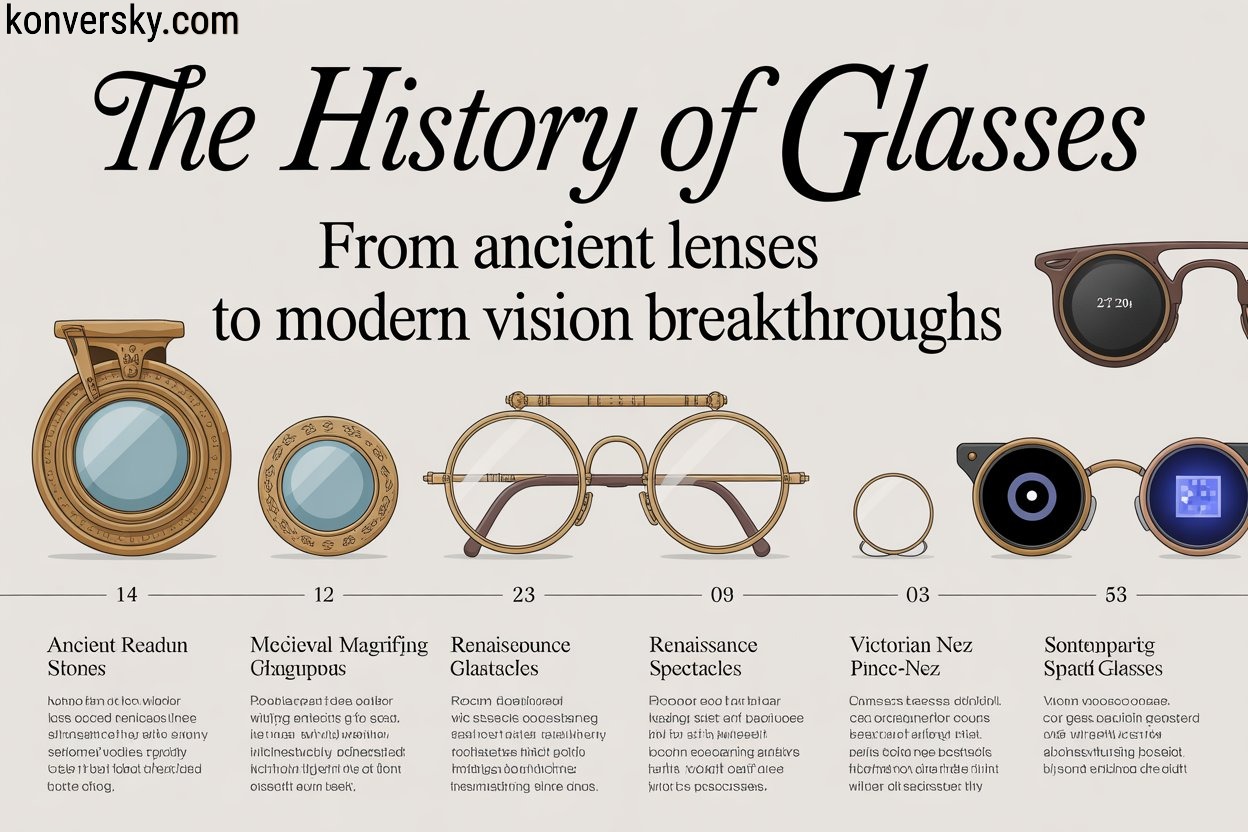
The history of glasses: from ancient lenses to modern vision breakthroughs
Introduction
Glasses have become an essential part of daily life, helping millions of people see clearly and perform routine tasks with ease. The history of glasses shows how simple vision aids evolved into indispensable tools for work, learning, and daily living. From reading books and using computers to driving and navigating busy streets, glasses enhance comfort, safety, and productivity. Over time, the history of glasses reflects both technological progress and changing fashion trends. Today, glasses are more than tools—they are cultural symbols, personal statements, and a testament to human creativity.
Early humans discovered that naturally shaped crystals and polished pieces of glass could magnify objects. This marked the first chapter in the history of glasses, as people began experimenting with ways to improve vision. Over centuries, inventors refined lens shapes, experimented with materials, and designed frames to make glasses wearable. Gradually, the history of glasses became a story of innovation, combining craftsmanship, science, and practicality. Scientific advances improved accuracy, while new designs made glasses more comfortable, accessible, and stylish. The history of glasses also reveals their cultural significance, symbolizing education, social status, and intellect in different societies.
This article explores the history of glasses in depth, tracing its journey from early magnifiers to modern eyewear. Readers will learn how lens-making experiments shaped functional and fashionable glasses, and how styles evolved over time. By studying the history of glasses, you can understand the ingenuity, creativity, and persistence behind each invention. From simple lenses to advanced modern glasses, the history of glasses highlights humanity’s ongoing quest for clear vision and improved daily life. Finally, the history of glasses shows how this humble invention has left a lasting impact on culture, technology, and personal well-being.
The Origins of Vision Correction
Long before modern glasses existed, humans sought ways to improve their eyesight. Ancient people discovered that curved pieces of crystal or glass could magnify objects, making small details easier to see. These early experiments form the beginning of the history of glasses, marking the first attempts at vision correction. Simple magnifying tools helped with reading, crafting, and observing nature. Even though these devices were rudimentary, they played an important role in the history of glasses. Over time, people experimented with different shapes and sizes, learning which designs worked best. These early tools laid the foundation for understanding vision and inspired future innovations, forming a key chapter in the history of glasses.
The materials used for early lenses were limited and imperfect. Natural crystals, polished glass, and even small water-filled spheres served as basic magnifiers. Each material had drawbacks: lenses could easily crack, distort images, or provide only minimal improvement. Despite these challenges, inventors and scholars continued experimenting, gradually shaping the next stage in the history of glasses. They refined lens shapes, polished surfaces more accurately, and slowly improved clarity. These early experiments were crucial steps toward creating lenses that could eventually be mounted in frames. Over centuries, these gradual improvements turned simple magnifiers into practical vision aids, setting the stage for wearable glasses that would reach wider populations, another milestone in the history of glasses.
Early vision aids also held cultural and historical significance. Access to lenses was often restricted to scholars, monks, and skilled craftsmen. They were considered valuable objects symbolizing knowledge, education, and social status. The spread of lens technology relied on trade, scholarly exchanges, and scientific discoveries, shaping the history of glasses worldwide. People began to recognize that vision correction could enhance daily life, from work and learning to personal comfort. These early efforts highlight human ingenuity and determination to overcome natural limitations. From crude magnifiers to carefully shaped lenses, the history of glasses demonstrates centuries of creativity, experimentation, and problem-solving that continue to influence modern eyewear and visual technology.
The Birth of Wearable Glasses
The first documented wearable glasses appeared in Italy during the late 13th century. Monks, scholars, and artisans were among the earliest users. These glasses rested on the nose without side arms. Their primary purpose was to aid reading, studying, and detailed work. Before this invention, people relied on simple magnifying lenses, which were not portable. Wearable glasses represented a major breakthrough, allowing users to correct vision while keeping their hands free. This innovation marked the beginning of practical, everyday vision correction for those who needed it most. Over time, designs evolved to become more portable, comfortable, and practical.
Craftsmen experimented with different shapes and sizes to improve fit and stability. Lenses were mounted in frames that could stay in place during reading or work. Side supports or straps were gradually added to keep glasses secure. Frames became lighter, more durable, and easier to carry. As designs improved, glasses became accessible to a wider range of people, not just scholars or clergy. These developments made vision correction a more common part of daily life, gradually integrating it into work, study, and personal activities. Materials and craftsmanship were crucial to the success of early glasses.
Lenses were made from polished glass or quartz, carefully shaped to improve clarity. Frames were crafted from wood, horn, or metal, often featuring detailed workmanship. Each pair required skill to balance weight, durability, and comfort. While these glasses seem simple today, they represented remarkable ingenuity at the time. The combination of functional lenses and wearable frames laid the foundation for centuries of advancement in eyewear. The birth of wearable glasses was not just a technological breakthrough—it was a cultural milestone, blending science, artistry, and practicality. These early innovations set the stage for future developments that would transform vision care and influence the design of glasses we rely on today.
Glasses Through the Renaissance
The Renaissance was a period of great scientific and technological progress, which had a significant impact on the development of glasses. Scholars and artisans began systematically studying optics, exploring how light could be manipulated to improve vision. Early lenses were shaped and polished with increasing precision to focus images more clearly. Advances in understanding magnification and light refraction allowed craftsmen to produce stronger, more accurate lenses. These improvements transformed simple magnifying tools into effective vision aids, marking a crucial turning point in the history of glasses. Science and practical experimentation combined to make lenses both functional and more accessible to those who needed them.
Several inventors and scholars played a key role in this transformation. Mathematicians, astronomers, and glassmakers experimented with grinding techniques and polishing methods that reduced distortion. They developed lenses capable of correcting farsightedness and nearsightedness more accurately than ever before. Important discoveries were documented and shared through books, workshops, and personal networks, allowing knowledge to spread across Europe. Vision experts built upon each other’s work, gradually improving the quality of lenses and the comfort of frames. These efforts laid the foundation for modern optics and ensured that vision correction became increasingly reliable for a wider audience, influencing the design and function of eyewear for generations to come.
The social and cultural significance of glasses also grew during the Renaissance. Scholars, merchants, and artisans wore them regularly, associating eyewear with learning, intellect, and professionalism. Glasses became symbols of knowledge and social status, rather than mere practical tools. Trade networks and communication between cities helped these innovations reach new regions, making glasses more accessible to ordinary people. As vision correction spread, it influenced daily life, education, and productivity. By the end of the Renaissance, glasses had evolved from rare instruments into widely recognized tools that combined functionality, artistry, and social meaning. This period set the stage for future advances in lenses and frames, shaping the cultural and technological development of eyewear for centuries.
Industrialization and Mass Production
The Industrial Revolution transformed the production, accessibility, and role of glasses in society. Before this period, glasses were handcrafted by skilled artisans. Each pair was unique but expensive, making them accessible only to the wealthy or scholarly elite. Mass production changed this entirely. Factories could now produce lenses and frames in large quantities with consistent quality. Standardized parts reduced costs and improved durability. Glasses became available to a much wider population. Ordinary workers, students, and merchants could finally afford practical vision aids. This shift turned glasses from a rare luxury into an everyday necessity for many people, fundamentally changing daily life and work. Technological breakthroughs in lens grinding and frame making played a crucial role in this transformation.
Machines allowed lenses to be cut, shaped, and polished with precision far beyond handcrafting. Early frames were constructed from metal, horn, and wood, with machine processes ensuring consistent strength and fit. Craftsmen focused on enhancing comfort, fit, and style, while machines handled repetitive tasks. Polishing techniques improved clarity and durability, producing lenses that were more effective than ever. These innovations created glasses that were reliable, practical, and comfortable for everyday use. Industrial technology combined with skilled craftsmanship made mass-produced eyewear both efficient and high-quality. Gradually, more people could enjoy the benefits of clear vision, helping them work, learn, and live more comfortably.
Alongside production advances, the professionalization of vision care became essential. Opticians emerged as experts in fitting lenses, recommending types, and ensuring proper use. Their work elevated glasses from a simple tool to a health-related necessity. Mass production and professional guidance together ensured clear vision was accessible and effective for a growing population. Society began to value glasses not only for practicality but also as instruments of education, productivity, and health. Industrialization changed not only how glasses were made but also how they were perceived and used. It set the stage for modern eyewear, combining technological innovation, skilled craftsmanship, and professional knowledge to create practical and reliable vision solutions that would benefit generations to come.
The 20th Century: Style Meets Function
The 20th century changed glasses from simple vision tools into fashionable accessories. Designers and brands began creating eyewear that reflected personality, status, and style. Iconic shapes like cat-eye frames, round lenses, and aviators emerged, becoming instantly recognizable. Fashion houses released collections that combined aesthetics with practicality. Glasses were no longer only a necessity—they expressed individuality. Over time, trends shifted with cultural changes, while classic styles remained popular across generations. People began to choose glasses that matched their personality, wardrobe, and lifestyle. The rise of fashion in eyewear made glasses a statement as well as a tool for better vision.
Technological innovations also shaped eyewear during this era. Bifocals became widely available, allowing people to see clearly at different distances without switching lenses. Tinted lenses and sunglasses added protection against sunlight while enhancing style. Lightweight materials like aluminum, titanium, and plastics made frames more comfortable and durable. Lens coatings reduced glare and scratches, improving functionality. Manufacturers experimented with new shapes, colors, and finishes to balance comfort, durability, and fashion. Eyewear became versatile, serving both practical and aesthetic purposes. These innovations allowed glasses to meet diverse needs, making them essential tools and personal accessories at the same time.
Glasses also gained cultural prominence through media and popular culture. Celebrities, movie stars, and public figures influenced trends and made eyewear aspirational. Films, magazines, and advertisements showcased stylish frames, inspiring people to adopt fashionable looks. Television and print media amplified these trends, making eyewear a visible part of daily life. By the end of the century, glasses had firmly established themselves as both functional tools and symbols of personal identity. They reflected social status, fashion sense, and cultural values. The 20th century demonstrated that eyewear could serve multiple roles: improving vision, enhancing style, and influencing society. This era laid the foundation for modern glasses, where technology, comfort, and design continue to evolve hand in hand.
Modern Innovations and Breakthroughs
Modern eyewear has undergone remarkable changes, combining technology, comfort, and style. Digital lens technology allows precise customization for each individual’s vision needs. Anti-reflective coatings reduce glare, improving clarity in bright light or while driving. Blue-light filters protect eyes from screens and digital devices, helping reduce strain. Progressive lenses and adaptive tints provide multiple functions in a single pair. These innovations make glasses more effective and versatile than ever before. Over time, lenses have evolved to suit modern lifestyles, offering both practical benefits and convenience. Eyewear today is designed to support everyday activities while maintaining visual comfort.
Smart glasses and wearable technology represent a significant leap in eyewear innovation. These devices integrate vision correction with digital features, such as augmented reality, notifications, or navigation. Some models include cameras, audio, and health-tracking sensors. This transforms glasses from simple vision aids into multifunctional devices. Users can access information, interact with apps, or enhance their environment without using their hands. Smart eyewear merges technology and design, making vision correction more interactive and versatile. These advancements expand the possibilities of what glasses can achieve, offering a blend of function, entertainment, and productivity.
Contemporary designs focus on balancing aesthetics with advanced functionality. Lightweight frames, durable materials, and ergonomic designs ensure comfort for daily wear. Styles range from minimalist and classic to bold and statement-making, allowing personal expression. Modern lenses often combine multiple features, including UV protection, scratch resistance, and adaptive light adjustment. Designers strive to create eyewear that meets both practical vision needs and personal style preferences. Glasses have become tools of self-expression, fashion statements, and technology platforms all at once. Today’s eyewear demonstrates how centuries of innovation have culminated in designs that are functional, stylish, and adaptable to modern life, reflecting the perfect union of science, art, and human creativity.
The Global Impact of Glasses
Glasses have profoundly transformed lives across the globe, improving vision and daily functionality. Corrected eyesight allows individuals to read, work, and navigate safely in everyday environments. Clear vision reduces accidents, prevents eye strain, and enhances focus during learning or work. Students benefit by reading textbooks and completing assignments efficiently. Workers in offices, factories, and healthcare perform tasks with greater precision. Over time, access to glasses has expanded, reaching communities once limited by geographic or economic barriers. Eyewear has become an essential tool for education, productivity, and safety. The global availability of vision correction demonstrates its role as one of the most influential innovations in human history.
Glasses are indispensable for education, work, and health, shaping opportunities across generations. Children and adults with access to corrective lenses can fully participate in classrooms, improving literacy and comprehension. Professionals, including surgeons, engineers, and craftsmen, rely on accurate vision to maintain precision and efficiency. Eyewear also supports mobility, independence, and quality of life for elderly individuals, reducing risks and promoting daily activity. Eye health benefits as glasses reduce strain and prevent complications from uncorrected vision. By enabling clearer sight, glasses contribute directly to social and economic progress. Over decades, increased accessibility has allowed millions to overcome limitations caused by poor vision, empowering them to pursue education, careers, and personal goals.
Cultural and regional differences influence how glasses are used and perceived worldwide. In some areas, they serve mainly functional purposes, while in others, eyewear is a fashion statement. Frame designs reflect local tastes, traditions, and trends, and popular media often shapes public perception. Celebrities, films, and advertising campaigns have made eyewear aspirational, blending style with practical benefits. Modern lenses, coatings, and multifunctional frames adapt to diverse cultural preferences while maintaining vision correction. This global diversity highlights how glasses have become more than a tool—they are symbols of identity, creativity, and social expression. From improving basic vision to shaping culture and lifestyle, eyewear continues to play a vital role in connecting science, health, and human experience worldwide.
Future of Glasses
The future of glasses promises remarkable innovation, personalization, and sustainability. Lenses will be fully customizable, allowing users to adjust focus, magnification, and tint for specific tasks. Frames are increasingly made from recycled, biodegradable, or eco-friendly materials, reducing environmental impact without sacrificing style. Designers are focusing on creating eyewear that is lightweight, durable, and comfortable for daily use. Over time, these trends will make glasses more adaptable to individual lifestyles, supporting both personal preferences and global sustainability goals. People will expect eyewear to combine fashion, function, and environmental responsibility seamlessly. Technology will continue to redefine how we see and interact with the world through glasses.
Smart lenses will overlay digital information, track health metrics, and assist with navigation. Lenses may automatically adjust to light conditions, screen use, or changing distances, ensuring perfect vision in every situation. Augmented reality integration could allow users to interact with virtual objects while performing real-world tasks. Eyewear may become a multifunctional device that enhances productivity, learning, and entertainment. This technological evolution transforms glasses from simple vision aids into versatile tools that support daily life in ways previously impossible. Smart eyewear could also provide real-time translation, reminders, or health alerts, blending functionality with convenience.
Predictions suggest that glasses will continue to evolve rapidly, integrating fully with digital ecosystems and interactive devices. Artificial intelligence may enable lenses to respond to voice commands, gestures, or environmental changes automatically. Despite these innovations, classic designs and traditional forms will remain popular, balancing fashion with technology. Future eyewear will seamlessly combine style, adaptability, and advanced features to meet the needs of diverse users. As materials, technology, and design continue to progress, glasses will not only improve vision but also enhance human experience, productivity, and connectivity. The future demonstrates that eyewear will remain an essential, evolving tool, blending science, creativity, and lifestyle to shape the way people see, interact, and live.
Conclusion
The story of glasses is a remarkable journey spanning centuries, evolving from simple magnifying lenses into sophisticated modern eyewear. Early tools helped scholars, artisans, and readers see details more clearly, improving work and learning. Over time, handcrafted lenses became portable and more widely accessible. Scientific discoveries refined lens accuracy, while industrialization introduced mass production, making glasses affordable for broader populations. Materials, craftsmanship, and technology combined to create eyewear that is reliable, functional, and increasingly stylish. Modern innovations, including smart lenses, adaptive tints, and sustainable frames, reflect how vision correction continues to adapt to human needs.
This evolution illustrates not only technological progress but also the enduring human drive to improve everyday life. Glasses have profoundly shaped education, work, and culture around the world. Students can study longer and read more effectively, while professionals perform tasks with precision and efficiency. Glasses enhance health, reduce strain, and improve safety, particularly for the elderly or those with visual impairments. Beyond practicality, eyewear has influenced fashion, personal identity, and social perception. Cultural variations in style and adoption reflect the unique ways societies value both function and aesthetics. Across generations, vision correction has enabled individuals to participate fully in society, highlighting how a simple invention can have far-reaching impacts on human progress.
Looking ahead, the future of glasses promises even greater innovation and integration. Customizable lenses, lightweight frames, and smart eyewear will continue to transform vision correction. Augmented reality, digital connectivity, and eco-friendly materials highlight the potential for multifunctional, sustainable eyewear. Classic designs will remain popular, blending tradition with cutting-edge technology. The evolution of glasses is a testament to creativity, adaptability, and human ingenuity. From humble beginnings to modern breakthroughs, eyewear demonstrates how a single invention can enhance vision, enrich daily life, and inspire curiosity. Glasses remain an enduring symbol of progress, reflecting the continuous pursuit of better vision, improved functionality, and meaningful style.
